Acupuncture and Resilience
By Beverley de Valois PhD LicAc FBAcC MBLS, Acupuncturist, Uxbridge
October is international breast cancer awareness month. This is a time to raise awareness about how acupuncture can support people with breast cancer during and after cancer treatment.
This October, I discuss the importance of resilience to people living with and beyond a diagnosis of breast cancer.
Resilience and Breast Cancer
Resilience. What is it? Why does it matter to people living with and beyond breast cancer? And what has acupuncture got to do with it?
What is Resilience?
Resilience is the “process of adapting well in the face of adversity, trauma, tragedy, threats, or significant sources of stress… the ability to “bounce back” from difficult circumstances....” 1
It is enabled through many factors, including personal control, positive emotions, optimism, and social support. It varies throughout life and can be developed by learning or developing coping behaviours.
Why Does Resilience Matter to Breast Cancer Survivors?
A diagnosis of breast cancer, and its subsequent treatment, can test and develop resilience. So too can living with the consequences of cancer treatments and adjusting to the “new normal” that is life after treatment ends. Cancer survivors can lose ability to “bounce back” and cope with life.
While some cancer centres promote the concept of developing resilience, this aspect of care does not receive enough attention. Helping people with cancer develop their resilience is essential to “whole person” health.2
What Has Resilience Got To Do With Acupuncture?
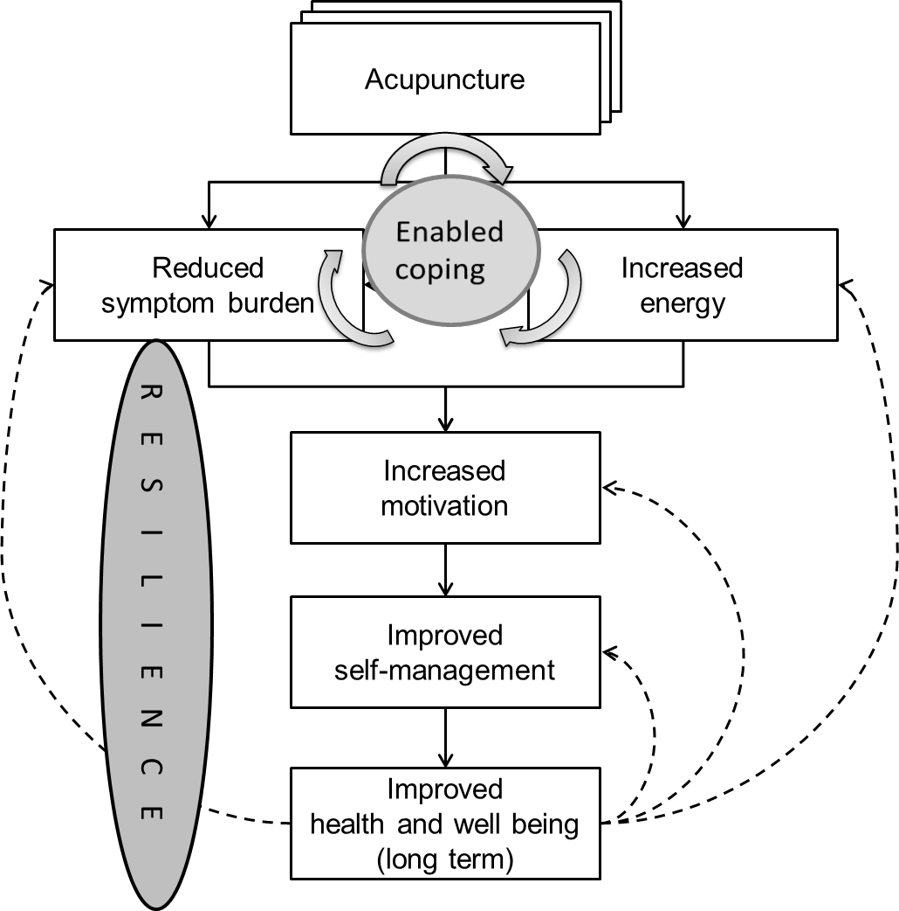
The model works in this way. People have acupuncture to relieve symptoms; what they often report is that they have more energy since having acupuncture. In this model, this synergy of acupuncture reducing symptom burden and increasing energy is labelled “enabled coping”, This was originally described by Dr Sarah Price, in her research into breast cancer patients’ experiences of having acupuncture whilst undergoing chemotherapy.5
Many positive outcomes become possible when the ability to cope in the face of complex health issues is facilitated. Individuals who have less discomfort and more energy may find they have more motivation, which in turn may lead to improved self-management. This can enhance overall wellbeing, which has further potential for generating ongoing cycles of continued self-management and improved wellbeing, thus contributing to the overall long-term health of the individual. In this scenario, acupuncture is a process that facilitates wellbeing, rather than a magic bullet targeted at a specific symptom.4
This is especially valuable for people with chronic illnesses that require on-going self-management to maintain and improve health. Cancer and cancer treatment-related lymphoedema are just two examples of this.
How Does This Work In Practice?
To illustrate this, it is helpful to look at what breast cancer survivors have said about their experience of having acupuncture. These quotations are from research participants, who have consented to use of their de-identified data, and who had 13 acupuncture treatments.4
We go out and we do things far more now than what we used to do, even this time last year I didn’t have the energy that I have now, it’s marvellous.” (004 BC)
“When I came back in January ... I said to her ‘I’ve joined Weight Watchers, I’m really being positive about this and I’m really working on my exercises for the lymphoedema, I’m really working hard’ … and I honestly say this is the acupuncture … it changed the way I thought about myself.” (004 BC)
I felt very energetic … I just felt woken up, you know, much more energetic. Which has continued, to be honest.” (002 BC)
“It was just a general feeling of wanting to get on and try something new and do something, … rather than ‘oh, I might do it tomorrow’, which was more the attitude previously.” (019 BC)
“Now getting up in the morning I have energy all day, whereas before I was on the couch in front of the telly, I couldn’t be bothered ... now I’m back and I’m doing, you know, my everyday life is normal. I feel like I’ve been given my life back.” (016 BC)
“It gave me so much confidence, I even changed my job! … I just started feeling so much better after the acupuncture. And I’ve gone back full-time, I was only doing part-time at the time, so all-in-all I’ve really got my life back.” (017 BC)
In summary, acupuncture can do so much more than manage symptoms. It can play an extensive role in helping breast cancer survivors cope much better with their diagnosis, treatment, and recovery from treatment. They can enjoy the ability to be better able to “bounce back” in the face of adverse events. Experience this for yourself – book an appointment now with me at Bridge to Health.
Further Information
Find out more about my work with cancer survivors at https://beverleydevalois.com/
Find out more about the Acupuncture for Cancer Survivors clinic at Bridge to Health Uxbridge https://www.bridgetohealth.co.uk/beverley-devalois
Get In Touch!
To book an appointment, please phone 01895 200050 and speak to Kate. Or to book online visit www.bridgetohealth.co.uk/booking
Beverley de Valois PhD LicAc FBAcC MBLS is a member of the British Acupuncture Council, whose commitment to excellence is recognised by the Professional Standards Authority (PSA), an independent body established by UK Parliament to protect the public by overseeing the regulation of healthcare professionals. As a PSA Accredited Register, the BAcC is trusted by major insurance providers and NHS employers, giving you confidence in the quality and safety of our members’ care.
References
1. American Psychological Association. Building your resilience. APA. Accessed 28 September, 2026. https://www.apa.org/topics/resilience/building-your-resilience
2. National Center for Complementary and Integrative Health. Whole person health: What it is and why it's important. National Institutes of Health. Accessed 28 September, 2026. https://www.nccih.nih.gov/health/whole-person-health-what-it-is-and-why-its-important
3. de Valois B, Young T, Melsome E. Assessing the feasibility of using acupuncture and moxibustion to improve quality of life for cancer survivors with upper body lymphoedema. European Journal of Oncology Nursing. 2012;16(3):301-309. doi:DOI:10.1016/j.ejon.2011.07.005
4. de Valois B, Asprey A, Young T. "The monkey on your shoulder": A qualitative study of lymphoedema patients' attitudes to and experiences of acupuncture and moxibustion. Evidence-Based Complementary and Alternative Medicine. 2016;Article ID 4298420doi:http://dx.doi.org/10.1155/2016/4298420
5. Price S, Long AF, Godfrey M. Exploring the needs and concerns of women with early breast cancer during chemotherapy: Valued outcomes during a course of traditional acupuncture. Evid Based Complement Alternat Med. 2013;2013:165891. doi:https://doi.org/10.1155/2013/165891