These Muscles Sound Like Harry Potter Spells…🪄
By Sian Smith, M.Ost, N.D, D.O, Registered Osteopath, Ealing and Uxbridge
I wonder where JK Rowling got her inspiration from…
Gluteus Maximus. Orbicularis Oculi. Flexor Carpi Ulnaris. Some of these muscles are just so satisfying to say. This blog will delve into some of the most commonly problematic muscles that present in clinic but that are also ridiculous sounding, and will make you feel like you are conjuring a spell right out of a wizarding book.
Quadratus Lumborum 🪄
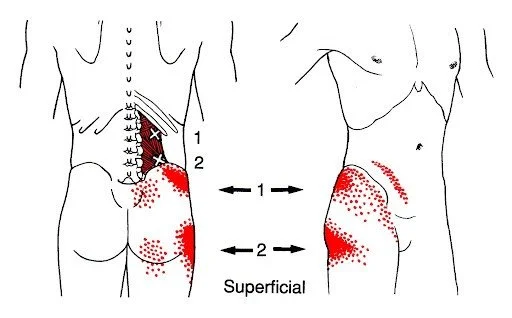
Quadratus Lumborum trigger point referral patterns
This is a frequent cause of lower back pain. Your quadratus lumborum muscle is located on each side of the deep lower back. It runs from the edge of the pelvic bone, running up to the lumbar spine and lower ribs. It is very deep, sitting close to the kidneys and, in some instances, kidney issues can cause this muscle to go into spasm. But more common causes are poor posture (regularly sitting with one leg crossed over another) and imbalances such as a scoliosis or pelvic misalignment. Other daily movements can be poor form when weight lifting (especially if the core muscles are not firing) and carrying children, especially if you always sit your child on the same hip.
When the quadratus lumborum muscle is in spasm, it feels deep and can be hard to pin point. The pain is often described as intense, sharp or stabbing. Trigger points that develop in this muscle can refer to the sacro-iliac joint, outer hip and buttock of the same side. Aggravating factors are bending, twisting and lifting.
How To Release a Quadratus Lumborum Trigger Point
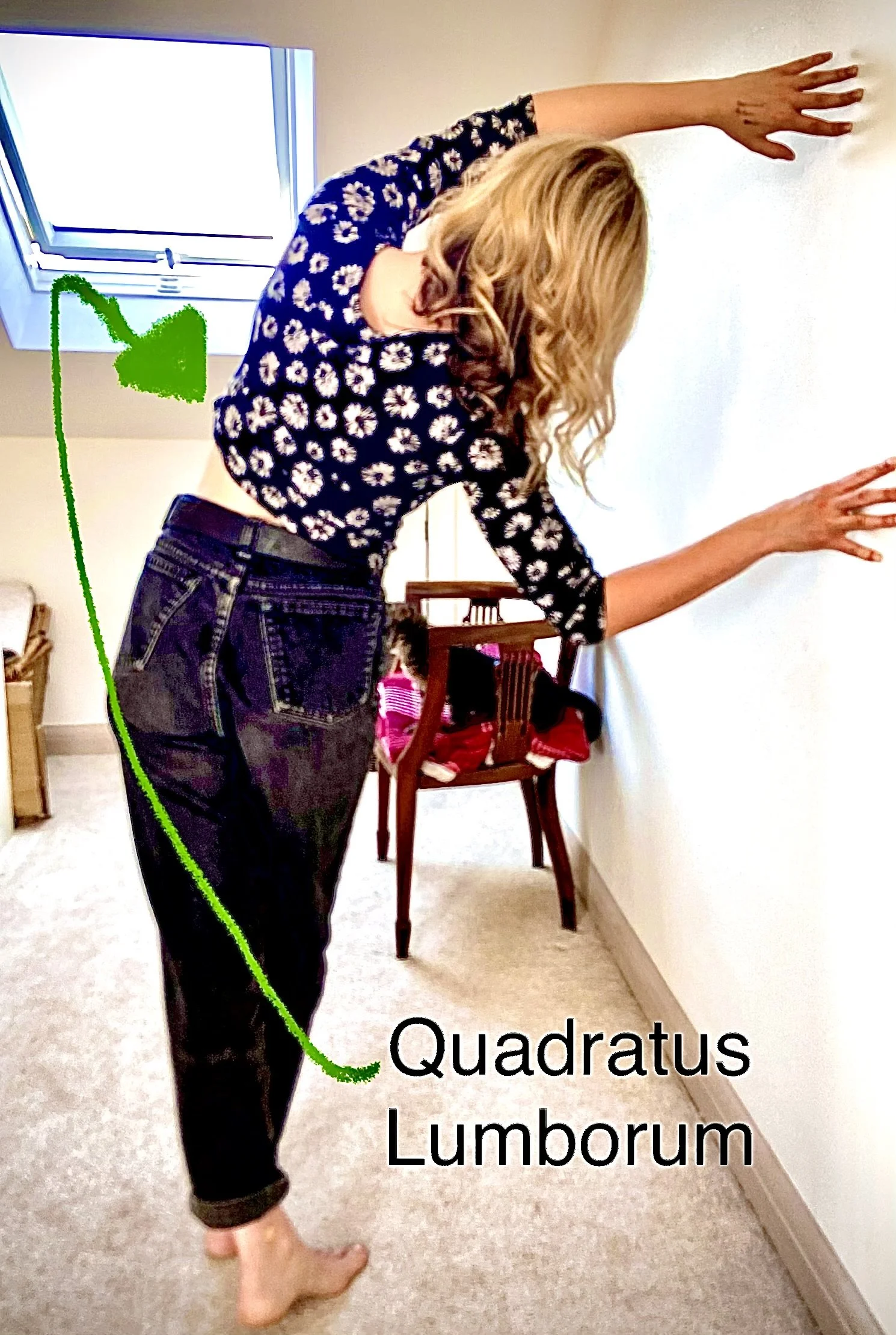
Quadratus Lumborum wall stretch
Trigger point release through massage or using a massage ball or foam roller is very effective. Other at home remedies include applying heat (to encourage blood flow and allow the muscle to relax) and gentle stretching (see below). For this stretch, it is best to cross one foot over another to anchor the pelvis down. Lean over into the wall and push your body away. To further target the quadratus lumborum muscle, rotate the front of your body towards the wall. Hold for 30-40 seconds.
Levator Scapulae 🪄
The levator scapulae muscles are located at the back of the neck and upper shoulder. They run from the very upper inner part of the shoulder blade to the upper neck vertebrae and are prone to over tightening. This tends to present as a stiff neck and intense pain at the upper back. Common causes of dysfunction are poor posture, hunched shoulders, holding your phone to your ear with your shoulder and even stress. Trigger points that build in this muscle tend to refer pain along the top of your shoulder or behind the shoulder blade.
What can be done? Applying heat to the area, trigger point release with a massage therapist or massage ball and gentle stretching (see below). For this stretch, place the arm of the side you are stretching behind you and tilt your head down and away – as if you are sniffing the opposite armpit. Place your free hand on the back of the skull and gentle draw your head down. Hold for 20-30 seconds.
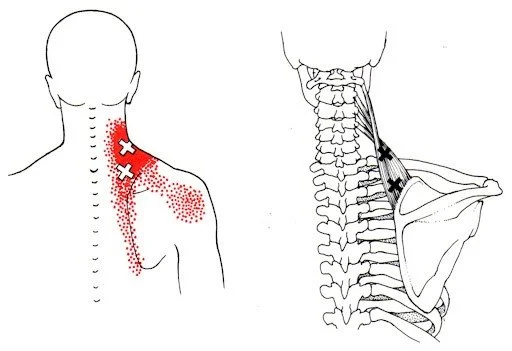
Levator Scapulae trigger point referral
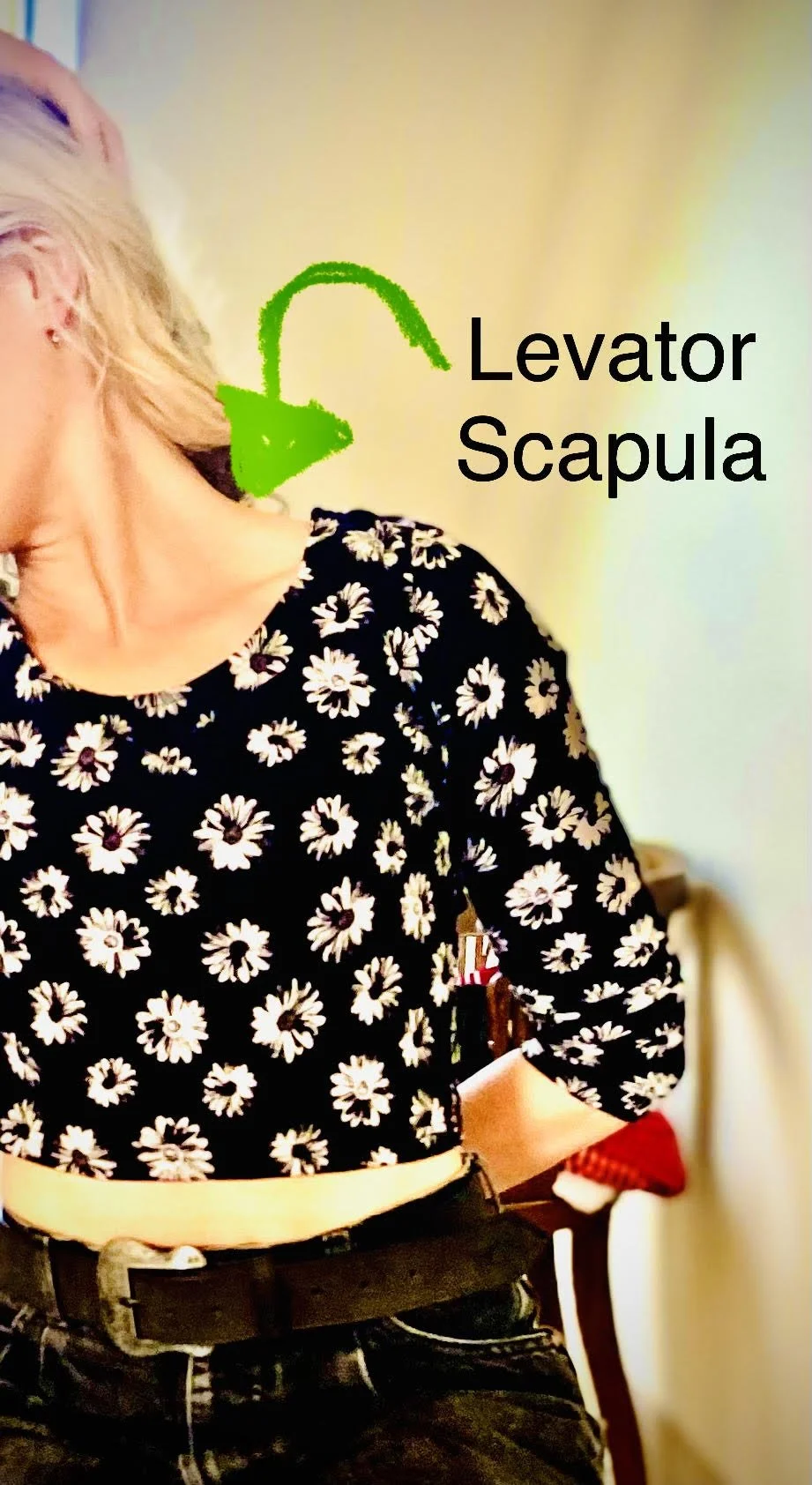
Levator Scapulae stretch
Latissimus Dorsi 🪄
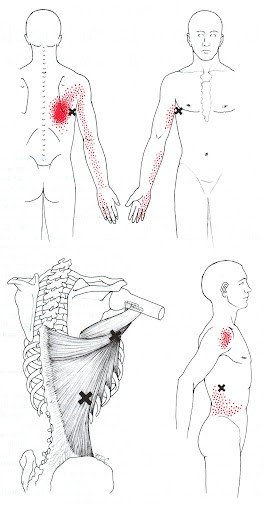
Latissimus Dorsi trigger point referral patterns
The latissimus dorsi is a beast of a muscle and unusual in that it spans from the lower back right up to the front of the shoulder. It originates at the T7-T12 vertebrae, iliac crest (pelvic bone), lower ribs and fascia of the lower back, attaching onto the front of the humerus. It acts as a lumbar spine stabiliser, contributes to deep breathing and some shoulder movement. It is a frequently strained muscle in the gym as it’s very active in pull ups, chin ups, rowing and climbing movements. Other main causes of strain are heavy lifting/manual work, poor posture (especially slumping forwards and rounded shoulders) and certain activities like swimming. Dysfunction at this muscle often causes a deep burning pain at the middle back and under the arm. Active trigger points can refer to the middle back and trunk, lower shoulder blade and sometimes down the arm to the 4th and 5th fingers.
How To Release a Painful Latissimus Dorsi?
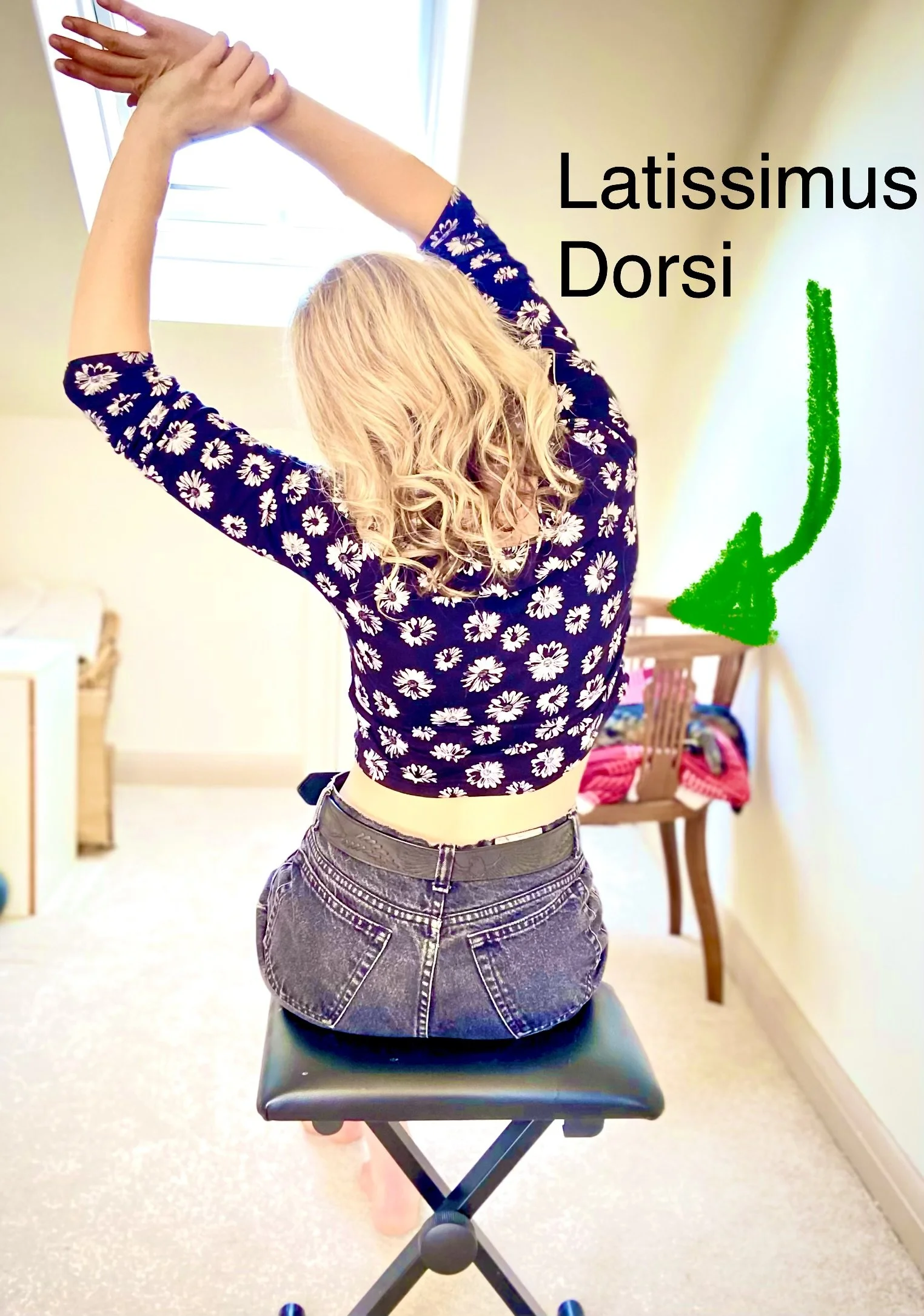
Latissimus Dorsi stretch
Again, applying heat helps to relax the muscle. Sustained pressure and self massage into any trigger points you find (usually around the back of the armpit or back of the shoulder blade) can help to calm it. Gentle stretching (see below) will reduce any middle back stiffness. The difference between this and the quadratus lumborum stretch is that you are lifting up through the arm with this stretch and shoulder feel it more around the outer shoulder blade and ribs. Hold for 30-40 seconds. And if all this fails, then see a manual therapist! Sports massage and osteopathy can help further identify any structural imbalances and use deeper techniques to rebalance the tissues.
Get In Touch!
Think you may have a pesky quadratus lumborum? Not sure if the stretch is quite getting it? Get in touch with our Uxbridge and Ealing osteopaths and sports massage therapists who can help identify the issue and alleviate pain. Find availability by calling Kate at help@bridgetohealth.co.uk or phone 01895 200050.